The discovery of William Pecker’s (1757-1820) stoneware kiln stands as a monumental milestone in American material culture. For generations, historic scholarship—including Lura Woodside Watkins’ (1897-1982) definitive 1950 work Early New England Potters and Their Wares—celebrated Pecker strictly as a master of red earthenware, operating in South Amesbury (now Merrimacport), Massachusetts, between 1791 and 1820. The widely accepted narrative asserted that early New England potters rarely expanded into stoneware, but this historical understanding completely shifted when my nephew Jason and I made an astonishing shoreline discovery along a high-tide cliff on the Merrimack River in 2013. Investigating a section of land once owned by Pecker, we noticed that heavy storm erosion had battered away a steep ledge, exposing old root systems. Embedded within the mud, roots, and receding tides lay a dense, 25-yard-wide concentration of forgotten artifacts, including deformed, vitrified kiln bricks melted by intense heat, stabilizing kiln furniture, and hundreds (likely thousands) of stoneware sherds detailing early forms like crocks and jugs, some adorned with cobalt-blue decoration, and others with an impressed bird decoration.
This physical evidence completely rewrote early New England industrial history by proving that Pecker built and operated a fully functional stoneware kiln on the Merrimack River. Rather than just importing stoneware or casually experimenting with it, Pecker trained as a stoneware potter in Manhattan, before establishing himself about 1810, as one of the absolute earliest potters in New England to successfully manufacture both red earthenware and stoneware simultaneously. This breakthrough bridged a massive missing link between the stoneware traditions of Manhattan, Boston and Charlestown, and regional rural Massachusetts craftsmanship. Because it shattered long-held assumptions and reconstructed some chapters of early New England trade from the ground up, top authorities hailed the find as “one of the great American discoveries of stoneware history.” We ultimately detailed this historic breakthrough in the book, South Amesbury’s Red Earthenware & Stoneware: The 1791-1820 William Pecker Pottery, and later curated an extensive exhibition at the Custom House Maritime Museum to return these recovered kiln fragments to public view for the first time in over two centuries.
Read more about this:
New England Antiques Journal (October 2013) – “Buried in Merrimacport? William Pecker, his pots and his kiln”
New England Antiques Journal (August 2015)– “William Pecker, a forgotten stoneware potter from Merrimacport, Mass.”
Potters on the Merrimac: A Century of New England Ceramics (Custom House Maritime Museum Exhibit Catalog, Newburyport, 2020)
South Amesbury’s Red Earthenware & Stoneware: The 1791-1820 William Pecker Pottery (Historic Beverly, 2021)
Antiques And The Arts Weekly (April 14, 2023) – “William Pecker: A Massachusetts Red Earthenware & New York City Stoneware Potter”

Over the years, we have uncovered substantial evidence proving that William Pecker produced stoneware alongside his traditional red earthenware after 1810. Pictured here is my nephew Jason, whose years of searching the shores of the Merrimack River helped bring many of these historic discoveries to light.
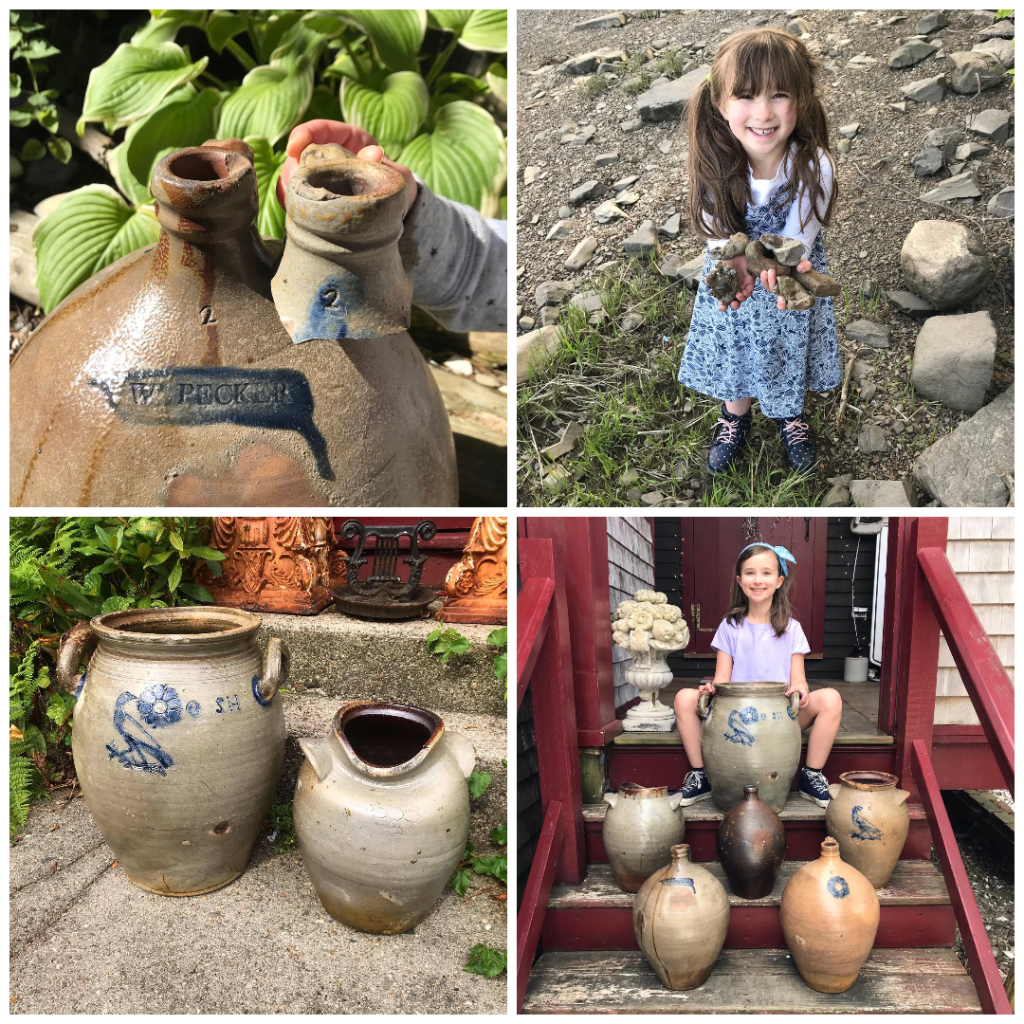
My niece Alexis is pictured here with artifacts collected from the William Pecker stoneware kiln site, alongside some of the finest known examples. These pieces are incredibly rare, as fewer than 20 or so examples are known to exist.
 EarlyAmericanCeramics.com